
Mexico's real estate market (June 2026)
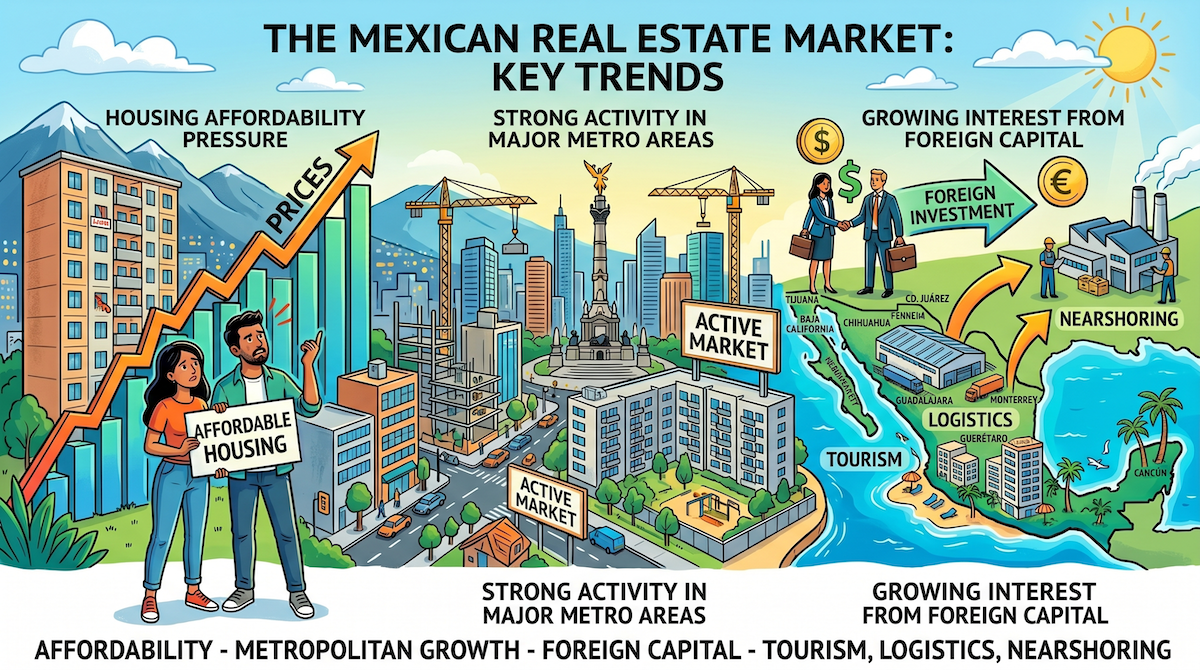
Mexico’s real estate market is being shaped by housing affordability pressure, strong activity in major metro areas, and growing interest from foreign capital, especially where tourism, logistics, and nearshoring create demand.
1) Housing demand and affordability
Mexico continues to face a meaningful housing gap, especially for middle- and lower-income households. BBVA Research notes that house prices have risen much faster than labor income, which has made affordability a central issue in the market. This creates demand for more compact, efficient, and better-located housing, while also limiting access for buyers who do not qualify for institutional mortgage programs.
2) Urban concentration and regional growth
Real estate activity remains highly concentrated in the country’s largest metropolitan areas, where most mortgage lending is still clustered. At the same time, new opportunities are emerging in northern states and in markets connected to industrial expansion and nearshoring. For investors, that means the best prospects are not only in the biggest cities, but also in secondary markets with infrastructure, employment growth, and logistics demand.
3) Foreign investment and legal structure
Foreign participation is active, but it must follow Mexico’s legal framework. Outside the restricted zone, foreigners can generally acquire property more directly, while inside the 100-kilometer border strip and 50-kilometer coastal zone, they usually need a fideicomiso, or bank trust, for residential property. In practice, the structure of the transaction matters as much as the property itself, because the wrong setup can create delays or compliance problems.
What foreigners should know
Foreign investors should first confirm whether the property is inside the restricted zone, because that determines whether a trust or other legal structure is required. They should also verify title, zoning, taxes, and registration requirements before signing anything, and use local legal and notarial support to avoid mistakes. If the investment is in a residential property inside the restricted zone, a fideicomiso is commonly used; if the purchase is through a Mexican company and the asset is non-residential, direct ownership may be possible under the applicable rules.
Market outlook
Overall, Mexico remains attractive because of its large internal market, macroeconomic stability, and strategic position in global supply chains. The strongest themes right now are affordability pressure, regional diversification, and the continued rise of foreign and industrial-linked demand. For a foreign buyer, the key is not only finding a good property, but choosing the right legal vehicle and the right location for the intended use.